
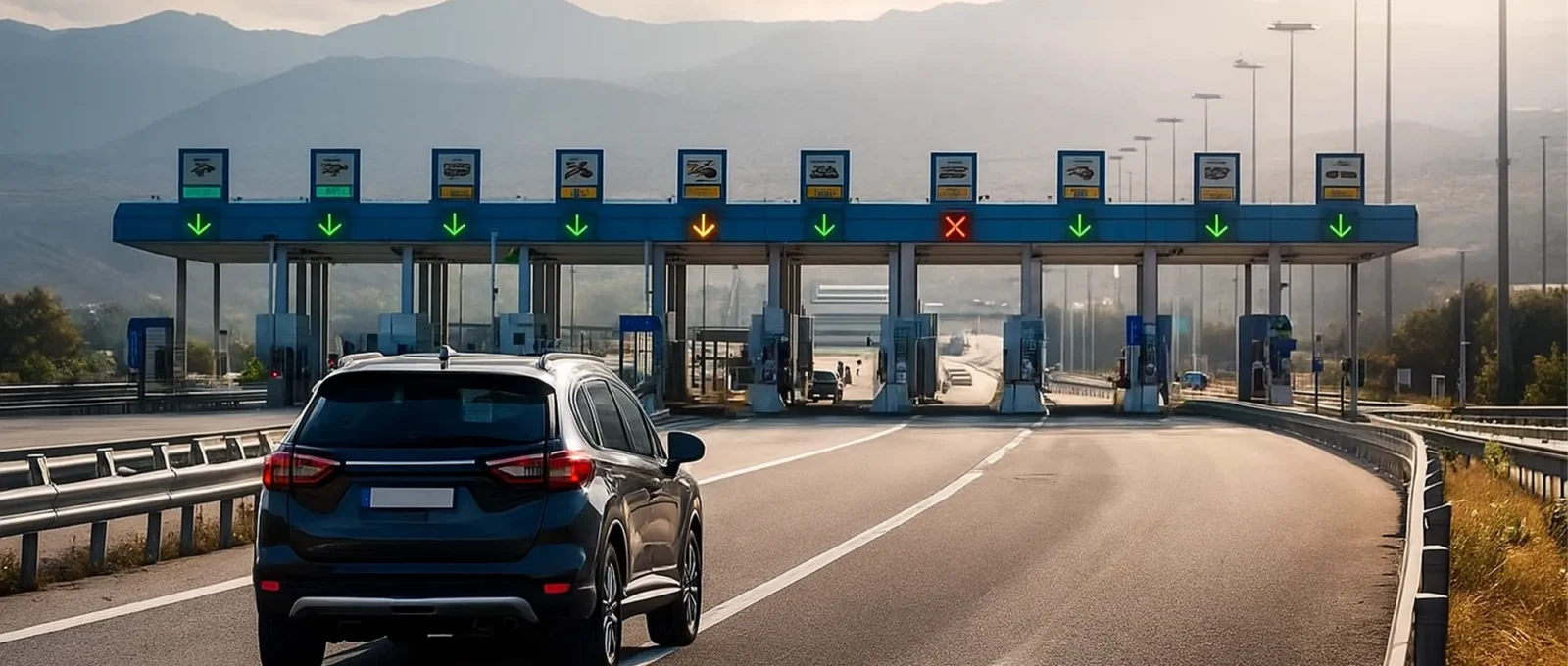

From the early 2000s until 2017, Greece went through one of the biggest infrastructure upgrades in its modern history. Supported mainly by European Union funding, the country’s highways were renewed and expanded, becoming some of the most scenic and well maintained roads in Southern Europe. With smooth tarmac, striking coastal routes, and long stretches that pass through mountains and valleys, Greece’s motorways offer an experience that feels as enjoyable as it is practical.
Using these roads comes with a cost, since most of the main routes include tolls, especially if you’re planning to understand how tolls in the Peloponnese work.
On average, you can expect to pay around nine euro for every one hundred kilometres you drive. The exact amount changes depending on the motorway, as each one is managed by a different concession company. Every company sets its own pricing, maintains its toll plazas, and operates its own electronic pass system. Since 2018, all systems have been fully compatible with one another, so any electronic pass works on every motorway in the country.
How to Pay Tolls in Greece
There are three main ways to pay:
- Cash, which is still accepted at most toll booths
- Credit or debit card, now available at many manned and automated points
- Electronic pass, a small device fixed to your windscreen that allows contactless payment and a faster experience
Interested in buying a car in Greece, click here to read our guide.
The Toll Network in the Peloponnese & Greece
Greece operates seven major toll highways and one toll bridge. Together they form the country’s main road network, connecting Athens with Thessaloniki, Patras, Kalamata, and the northern and western borders.
Main Toll Highways
A1 from Athens to Thessaloniki and Evzonoi
- Start: Athens, Metamorfosi interchange
- End: Evzonoi at the border with North Macedonia
- Length: approximately five hundred and fifty kilometres
A2 also known as Egnatia Odos and running from Igoumenitsa to Alexandroupoli and Kipoi
- Start: Igoumenitsa on the Ionian Sea
- End: Kipoi at the border with Turkey
- Length: approximately six hundred and seventy kilometres, making it one of Europe’s longest continuous motorways
A5 also known as Ionia Odos from Rio to Ioannina
- Start: Rio near Patras, via the Rio Antirrio Bridge
- End: Ioannina in Epirus
- Length: approximately one hundred and ninety six kilometres
A6 known as Attiki Odos, the ring road of Athens
- It circles the capital and connects with Athens International Airport
- Length: approximately seventy kilometres
A7 known as Moreas Motorway from Corinth to Tripoli and Kalamata, with a branch to Sparti
- Start: Corinth
- End: Kalamata and the Sparti connection
- Length: approximately two hundred and five kilometres
A8 also known as Olympia Odos from Elefsina to Corinth and Patras
- Start: Elefsina, west of Athens
- End: Patras
- Length: approximately two hundred and two kilometres
A11 from Schimatari to Chalkida in Evia
- Length: approximately eleven kilometres
Rio Antirrio Bridge, also known as the Charilaos Trikoupis Bridge
- Length: two point nine kilometres
- Connects the Peloponnese with Central Greece
Example Toll Prices for Cars
| Motorway | Toll Plaza | Price (€) | Operator | Website |
|---|---|---|---|---|
| A1 Athens–Thessaloniki | Afidnes | 2.35 | Nea Odos / Aegean Motorway | neaodos.gr |
| A2 Egnatia Odos | Polymylos | 2.40 | Egnatia Odos S.A. | egnatia.eu |
| A5 Ionia Odos | Ioannina | 3.20 | Nea Odos S.A. | neaodos.gr |
| A6 Attiki Odos | All entries | 2.80 | Attiki Odos S.A. | aodos.gr |
| A7 Moreas | Kalamata | 3.70 | Moreas S.A. | moreas.com.gr |
| A8 Olympia Odos | Rio | 3.20 | Olympia Odos S.A. | olympiaodos.gr |
| A11 | Chalkida | 1.55 | Nea Odos S.A. | neaodos.gr |
| Rio–Antirrio Bridge | Main toll | 15.40 | Gefyra S.A. | gefyra.gr |
The Electronic Pass System
For anyone who drives regularly, an electronic pass is worth considering. Apart from the convenience, some operators offer a distance based system. If you enter the motorway and exit before the next full toll plaza, you pay only for the distance covered rather than the entire section.
Driving through Greece is one of the best ways to experience the country’s landscapes. From the olive covered hills of the Peloponnese to the dramatic mountains of Epirus, the views are unforgettable. The toll system may feel a bit complex at first, but once you learn how it works, it becomes very simple and ensures that the highways remain in excellent condition.
For anyone planning a road trip or considering a move or property purchase in Greece, understanding the toll network is part of settling in and moving around comfortably.
At My Peloponnese, we share practical information to help you understand the region, explore it with ease, and discover the opportunities it offers for travel and everyday living.


